OGS Rock Core Workshop May 21, 2026
-
OGS Rock Core Workshop May 21, 2026: The Clinton Complexity—High-Resolution Mapping of Reservoir Sandstones in Southeastern Ohio, Mindy Thomas
May 21, 2026
12:00 pm - 2:00 pm
The Ohio Geological Society
Rock Core Workshop

THURSDAY, MAY 21, 2026
Lunch & Talk Begin at 12:00 PM
Horace R. Collins Laboratory & Core Repository
3307 South Old State Road
Delaware, OH 43015
Lunch provided for registered attendees.
The Clinton Complexity—High-Resolution Mapping of
Reservoir Sandstones in Southeastern Ohio
Mindy Thomas, Ohio Geological Survey
Abstract: This talk will describe rock core and petrophysical testing of core from the Clinton Sandstone with examples of the core from the H.R. Collins Core Repository for your perusal!
As carbon capture, utilization, and storage (CCUS) continues to be of interest in legacy oil fields around the U.S.—particularly in Ohio’s Appalachian Basin—the Grimsby Sandstone, often referred to as the “Clinton Sandstone,” remains a viable CCUS candidate, both as a depleted reservoir and for enhanced oil recovery. Multiple Clinton fields in Ohio have recently been remapped and reexamined, as seen in the Midwest Regional Carbon Sequestration Partnership’s report (2020). However, the Gore Consolidated Oil Field (GCOF) of southeastern Ohio has received limited attention, primarily for economic considerations, leaving a gap in understanding its detailed geology. Since its discovery in 1907, James W. Castle has done the most work on Clinton Sandstone in the GCOF, which was published in 1998 and 2001. Sands identified by Castle in available cores were all interpreted as marine shoreface deposits, including shelf-bar complexes dominated by waves and tides before a returning transgression shifted the siliciclastic depositional environment back to a widespread carbonate factory.
From 2024–2025, this study reexamined and compared all available Clinton GCOF cores studied by Castle and stored at the Ohio Geological Survey core repository. Additional data for the cores were collected through the DOE’s National Energy Technology Laboratory, including XRF analyses and CT scans showing overlooked features such as marine ichnofossils, cementation variation, and subtle bedding. New, detailed core descriptions were completed along with facies descriptions and interpreted depositional environments.
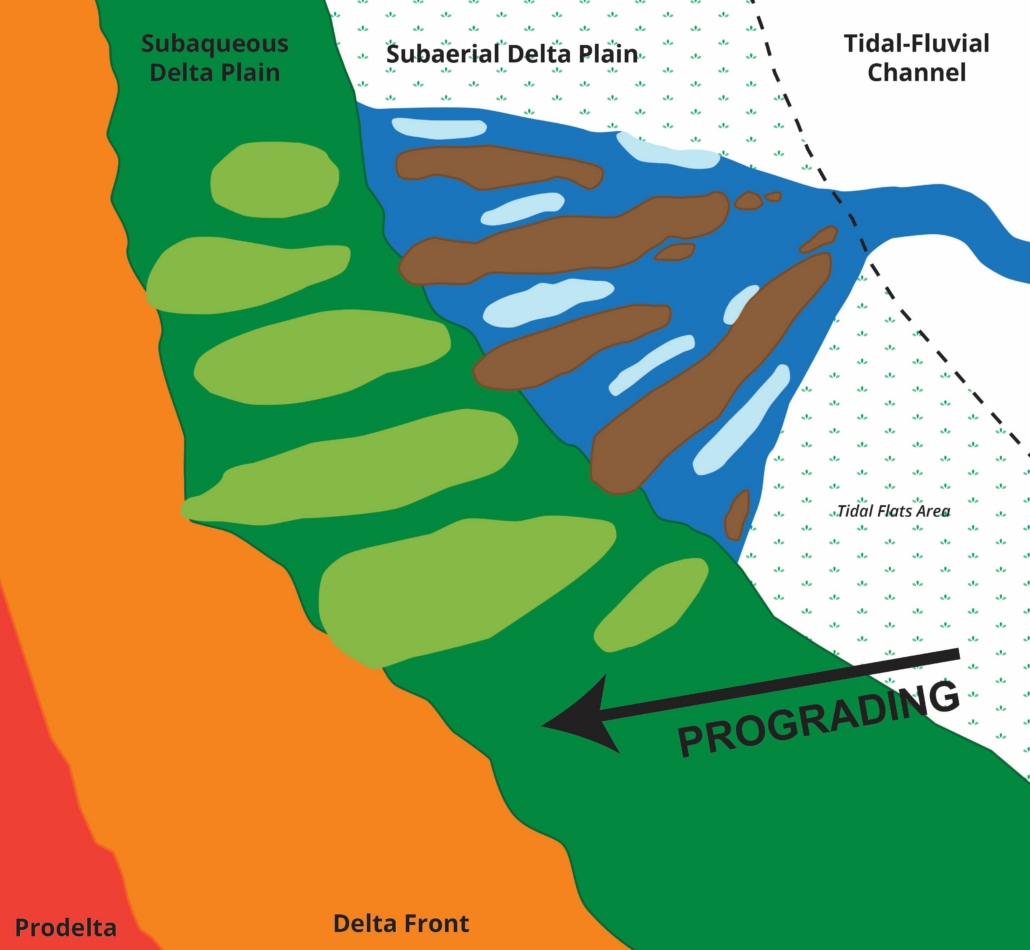
This study then took the work a step further and utilized that core work, 117 digitized LAS well logs, and over 950 depth-registered raster geophysical logs in the GCOF to apply sequence stratigraphic principles to the Clinton Sandstone. Sequence boundaries and major/minor flooding surfaces were identified; in addition, shale/sand cutoffs were applied on gamma-ray logs to more accurately map sand-body morphologies at a high resolution in the field between stratigraphic surfaces. Net sand maps and cross sections generated for the GCOF—along with prior core work—showcase the incredible heterogeneity present in the Clinton reservoir, which is now reinterpreted as a potentially tidally influenced deltaic paleogeographic setting with associated depositional environments. Understanding the complex heterogeneity of the sand-body morphology presented is critical for assessing the viability of the Clinton GCOF as a future carbon storage unit.

Venue: Horace R. Collins Laboratory & Core Repository
Venue Phone: 740-548-7348
Venue Website: https://ohiodnr.gov/discover-and-learn/safety-conservation/about-ODNR/geologic-survey/hrc-lab-core-repository/
Address:
Description:
The ODNR Division of Geological Survey Horace R. Collins Laboratory is a multi-use facility located at Alum Creek State Park in Delaware County, Ohio. Core, sample, and twelve other collections are housed at the Ohio Geological Sample Repository. One wing of the facility has laboratories for core and sample description and analysis, petrographic studies, aggregate testing, and sedimentation research. A second wing houses Division of Watercraft Central District offices. The Collins Lab also headquarters the Ohio Seismic Network and the Lake Erie Data Center.